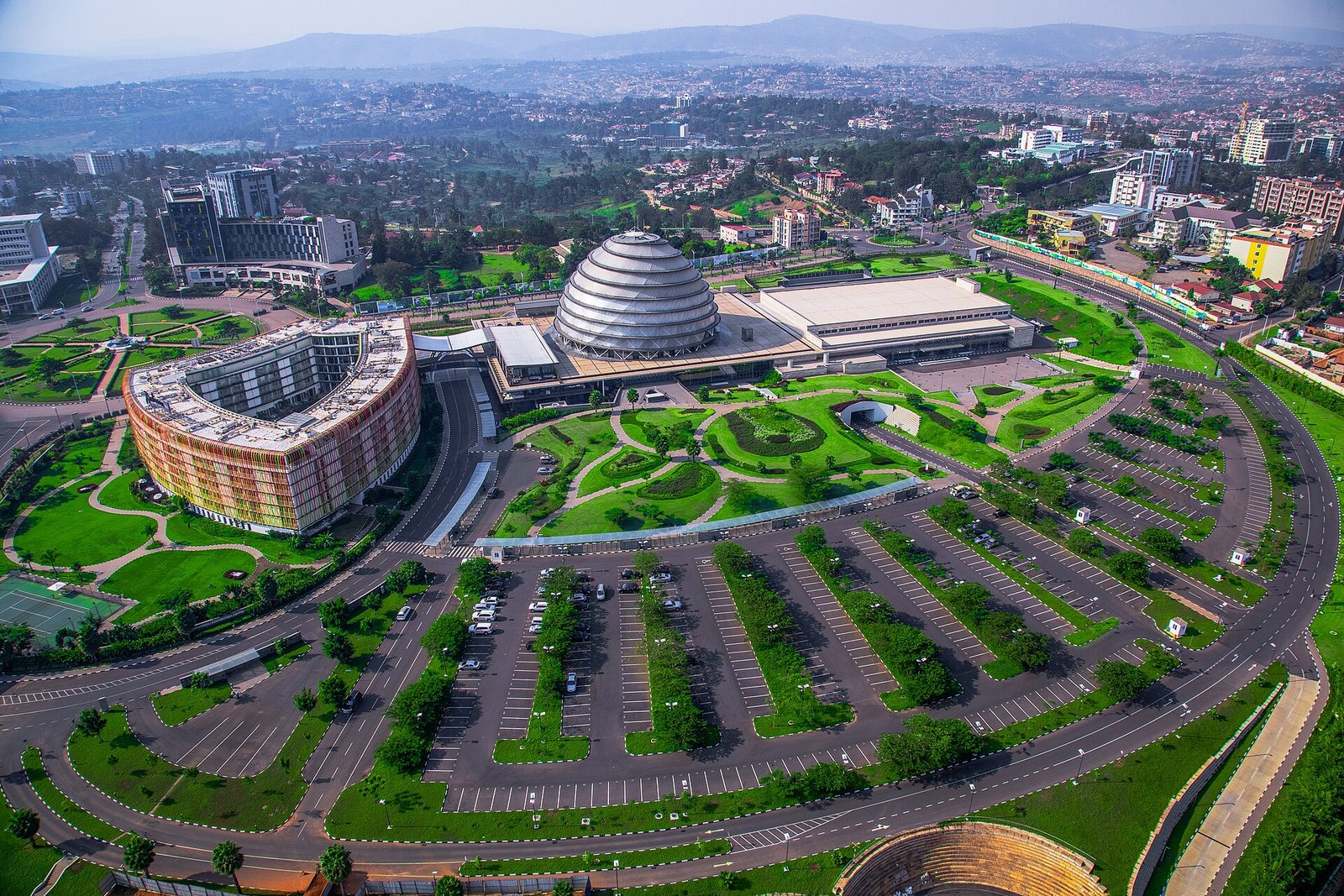
Photograph: An aerial of Kigali Convention Center on June 19, 2019 by Emmanuel Kwizera, via Wikimedia Commons, CC BY-SA 4.0
Corporate travel's money is coming back. East Africa is the market buyers have been told to squeeze.
Global business travel spend is forecast to rise 7.2% this year on trip volumes up just 1.3%, while Africa's average room rate fell 19.8% and Kenya's fell 22.2%. The rebound reaches East Africa as a rate negotiation, not a volume windfall.
On 22 September the Global Business Travel Association published the results of a poll it had run between 27 August and 9 September, covering 604 corporate travel managers, suppliers and intermediaries worldwide. The headline was cheerful and was reported as such. Optimism about the next twelve months had climbed to 63 per cent, the highest reading of 2026, up from 41 per cent in April. Pessimism had collapsed from 24 per cent to 7 per cent.
Read one line further and the mood changes. Fifty-six per cent of buyers expected their travel spending to rise. Forty-five per cent expected the number of trips to rise. Sixty-nine per cent named rising costs as their single biggest concern.
That eleven-point gap is the story, and it is not a rounding error. It is the same gap GBTA had already put a number on seven weeks earlier. Its Business Travel Index, released on 3 August, forecast global business travel spending of $1.71 trillion in 2026, up 7.2 per cent, on 1.84 billion trips, up 1.3 per cent. Money rising at five times the rate of volume is not a recovery in travel. It is a recovery in the price of travel.
Suzanne Neufang, chief executive of GBTA, put it without decoration. "The big story this year is that companies haven't stepped away from travel, but they are increasingly more selective and productivity-focused," she said when the forecast was published. Two months later, announcing the September poll, she added the other half: "Rising costs and geopolitical risk are now part of everyday planning for managed travel programs."
For a hotel owner in Nairobi, Kigali, Dar es Salaam or Kampala, the instinct on reading that a record $1.71 trillion is about to move through corporate travel budgets is to plan for arrivals. That instinct is the wrong one, and the reason is sitting in the region's own rate data.
FCM Consulting, the advisory arm of one of the larger global travel management companies, published its 2026 hotel insights report in May. Its African numbers, drawn from rolling twelve-month data to late 2025, do not read like a market with pricing power. The continental average room rate had fallen 19.8 per cent. Kenya was down 22.2 per cent. Ethiopia was down 31.1 per cent. Ghana was down 42.2 per cent. Against that, Johannesburg was up 23.6 per cent in the fourth quarter of 2025 and Cairo up 12 per cent, lifted by South Africa's G20 hosting year and by North African leisure demand.
What Mummy Mafojane, general manager of FCM South Africa, then said about those numbers is the most consequential sentence published about East African hotel pricing this year, and it was not addressed to hoteliers at all. It was addressed to the people who buy from them.
"Where rates are softening, buyers have a genuine opportunity to consolidate volume and push for preferential corporate rates," she said. "Where rates are climbing, the focus has to shift to compliance."
That is the transmission mechanism, stated plainly by the buy side. A rising global corporate travel budget does not arrive in a market as extra demand. It arrives as a procurement exercise, and the advice going into that exercise is to take the volume to wherever rates are soft and extract a preferential rate for bringing it. On FCM's own table, East Africa is where rates are soft.
| Direction | Period | |
|---|---|---|
| Global corporate travel spend | +7.2% to $1.71trn | 2026 forecast |
| Global corporate trips | +1.3% to 1.84bn | 2026 forecast |
| Africa average room rate | -19.8% | rolling 12 months to late 2025 |
| Kenya average room rate | -22.2% | rolling 12 months to late 2025 |
The picture is not uniform, and the region's defenders have a fair point to make. In the same commentary Mafojane noted that Nairobi, alongside Johannesburg, Cape Town, Cairo and Rabat, was actually up on 2024 rates, while Windhoek, Gaborone, Lagos and Luanda fell. So Kenya's country average and its capital point in opposite directions. That does not soften the argument, it locates it. The compression is happening outside the capital: in coastal conference stock, in secondary-city business hotels, in the upcountry properties whose meeting rooms are sold to ministries, agencies and non-governmental organisations rather than to multinationals.
Kenya's own statistics explain why that exposure is structural rather than cyclical. The Kenya National Bureau of Statistics reported in May that of 2.55 million international arrivals in 2025, holiday travel accounted for 47.8 per cent and business for 25.2 per cent. Local conferences numbered 12,671, up 12.9 per cent. Hotel bed-nights rose 12.6 per cent to 11.56 million, while domestic occupancy sat at 45 per cent.
A quarter of arrivals coming for business, and a conference count growing at nearly 13 per cent, sounds like strength. The question is who those buyers are. Håvar Bauck, founder of the Nairobi-based distribution firm HotelOnline, answered it in June while arguing, correctly, that the city's long-run demand trend is upward. "Nairobi is becoming more important as a diplomatic and United Nations city," he said.
He meant it as reassurance, and as a description of durable demand he is right. But a diplomatic and institutional buyer is the least upwardly price-elastic customer in hospitality. It books through a tender with a published rate ceiling, against a per-diem set by a finance department in another country, approved by a committee whose incentive is to be seen to have paid less than last year. It does not pay a premium for a renovated lobby or a better breakfast, and it cannot be upsold. When global corporate budgets rise 7.2 per cent, that money flows to suppliers who can be re-rated. An institutional rate card is not one of them.
Supply then decides who holds the pen. Trevor Ward, managing director of W Hospitality Group, described Nairobi's position in June: roughly 20 new branded hotels of about 3,650 rooms in the pipeline at the start of 2026, some 1,500 rooms expected to open this year, on top of around 2,000 branded rooms added since 2023, with occupancy already down close to ten percentage points.
"While Nairobi is a big market with various sub-markets, that's a lot of new rooms for any African city to absorb," Ward said. "Clearly, occupancies and rates will continue to be at risk as more and more rooms enter the market." His remedy was blunt and pointed at the right target: "The industry needs to work with government to increase demand to match the increases in supply."
Michael Pownall, co-founder and managing partner of Valor Hospitality, sees the capital differently, and his reading is worth holding alongside Ward's. "Nairobi remains an undisputed heavyweight," he said. "The fact that the city continues to attract significant institutional capital and boasts a record development pipeline demonstrates the confidence investors have in the market." Both men can be right. Investor confidence and owner returns are not the same variable, and Pownall's own framing concedes the distinction: "Investors are no longer chasing vanity metrics such as room counts."
Kenya's stated answer to all of this is volume. In July, Julius Bitok, principal secretary in the Ministry of Tourism and Wildlife, and June Chepkemei, chief executive of the Kenya Tourism Board, set out a target of five million international arrivals a year by 2028, with business events as a principal engine. "Kenya's expanding world-class venue capacity must be matched by an equally aggressive push from both the government and the private sector to firmly establish the country on the global events calendar," Bitok said.
Venue capacity is not the binding constraint, and the proof is some 1,150 kilometres away. Kigali has been ranked second in Africa for international association meetings by the International Congress and Convention Association for two consecutive years, behind Cape Town, which took first place on 55 qualifying meetings in 2024. It has done so on a room stock a fraction of Nairobi's, because since 2014 it has sold a brokered bid through a national convention bureau rather than selling rooms. An association looking for a host city is handed one counterparty, one costed proposal and one accountable owner of the outcome.
Nor is Rwanda immune to the same squeeze, which is instructive in itself. Its delegate numbers fell from more than 65,000 in 2023, worth roughly $95 million, to more than 52,000 in 2024, worth roughly $84.8 million. Its stated response is a 2029 revenue target of $224 million: a bet on value per delegate, not on headcount. That is the correct bet in a market where spend is rising five times faster than trips, and it is the opposite of a five-million-arrivals target.
The operational conclusion follows from the arithmetic. If the global buyer's budget is growing while their trip count is not, then every trip they still take has to be defended internally, and the supplier who helps them defend it is the one who keeps rate. Rachel Newns, global hotel practice lead at FCM Consulting, described what the buyer is now buying: "Travel is now more focused on bringing people together with purpose, whether for client work, revenue generation, or internal alignment." Edward Galvin, vice-president and head of North America at Visa Commercial Solutions, described what they need in order to keep buying it: "Organizations need greater visibility, control and flexibility to manage rising travel costs and measure ROI."
Neither of them asked for a discount. That is the point East African operators should take from a week of otherwise encouraging global data. The 2027 corporate rate season will open on a market where the money is real, the volume is flat, and the region's published rate history reads as an invitation. A hotel that answers a tender by shaving its rate has conceded the only asset it controls. A hotel that answers with evidence of what the trip achieved, length of stay, meeting outcomes, total trip cost rather than nightly rate, is selling the thing the buyer has been told to look for.
The money is coming. Whether it arrives as rate or as a rate cut is being decided now, in procurement documents nobody in the region is being shown.
📣 Telegram 💬 WhatsApp 💼 LinkedIn 📚 All guides