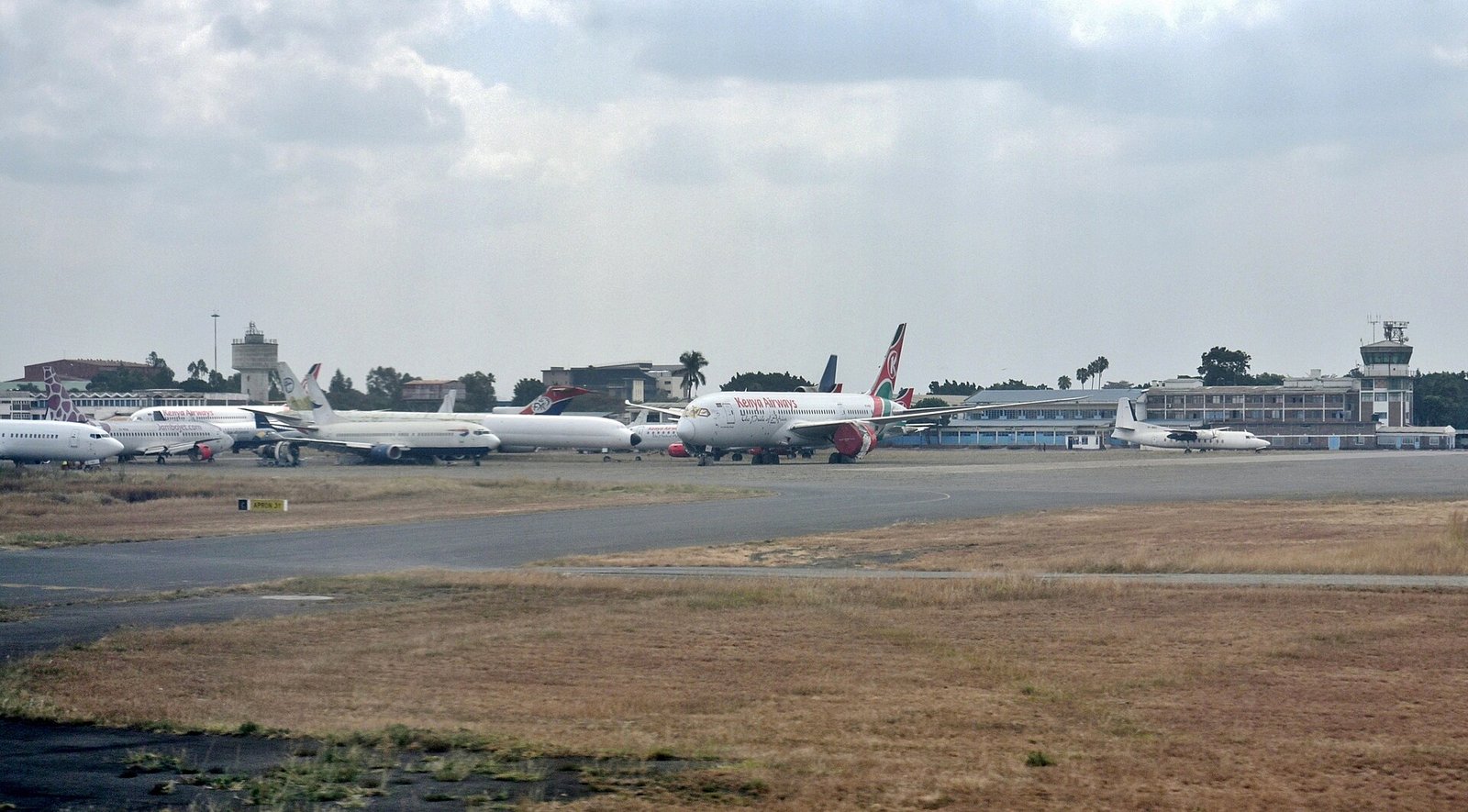
Airliners Nairobi 2025 (02) · Bahnfrend · via Wikimedia Commons · CC BY-SA 4.0
East Africa's route map is being rebuilt. The fares are set somewhere else.
Four new services in eleven weeks will stitch the region together more tightly than a decade of open-skies communiqués managed. Buyers are signing 2027 rates against flights that have not yet flown a single season.
At the Sarit Expo Centre in Nairobi on the morning of 9 September, Kamil Alawadhi stood in front of a room of African airline chief executives, airport directors and regulators and told them, with numbers, why their industry costs too much.
Alawadhi is the International Air Transport Association's regional vice-president for Africa and the Middle East. The occasion was the tenth Aviation Africa Summit, a two-day event hosted by Kenya's State Department for Aviation and Aerospace Development, the Kenya Civil Aviation Authority, the Kenya Airports Authority and Kenya Airways. His brief was the cost base. Taxes and charges across the continent, he said, run at least 15 per cent above the global average. Fuel is 17 per cent more expensive than the world price and accounts for 40 per cent of an African airline's operating costs, against 25 per cent globally. Between 2020 and 2025, only 16 per cent of accident reports in Africa were completed and published to the standard the International Civil Aviation Organisation requires.
Then he put the question that the rest of the summit circled without quite answering. "The choice facing governments is clear," Alawadhi said. "Should aviation be treated primarily as a source of revenue or as an engine of economic development? Countries that prioritise connectivity benefit from stronger trade, tourism and investment growth."
Alan Peaford, who chairs Times Aerospace Events and has watched this conversation recur for a decade, was blunter about the stakes. "Africa cannot, and will not, realise the full promise of its economic integration without a stronger aviation sector," he said.
None of that is new. What is new is the timetable sitting underneath it. In the eleven weeks from the start of October, four separate schedule changes will do more to physically connect East Africa's tourism geography than any open-skies communiqué has managed since the Yamoussoukro Decision was signed. And almost all of it will happen after the contracts for 2027 have been agreed.
On 1 October, Jambojet returns to Entebbe after a six-year absence, flying Nairobi daily with a Dash 8-Q400 and one-way fares reported from about US$170. On 27 October, Uganda Airlines opens Entebbe to Accra four times a week, using a Boeing 737-800 wet-leased from Ethiopian. On 18 November, the same airline puts a Bombardier CRJ-900 on a daily Entebbe to Kigali rotation, a route RwandAir has effectively owned for years. And on 30 November, Ethiopian Airlines takes its Addis Ababa to Kilimanjaro to Zanzibar rotation from the three weekly frequencies originally filed to seven, lifting its combined service into those two airports from seventeen or eighteen weekly to twenty-one.
Read as a list, that is four airline press releases. Read as a map, it is the first credible answer to a problem East African operators have complained about for twenty years: the region sells itself as a single multi-country destination while remaining, in practice, extremely difficult to travel as one.
The Kigali route is the clearest illustration. Bwindi and Volcanoes are ninety minutes apart by road across a single border, and they are the two anchors of the most valuable primate circuit on the continent. Until now, selling them together in one itinerary has meant either a long drive or a connection routed through somebody else's hub. A daily jet between the two capitals is not a marketing improvement. It is a product that did not previously exist.
Girma Wake, Uganda Airlines' acting chief executive, framed the expansion in hub terms rather than tourism ones. "Building the structure for people to connect through Entebbe will improve the financial situation of the airline," he told reporters. Wake is a former chief executive of Ethiopian Airlines and a former chairman of RwandAir, installed at Entebbe by presidential directive in February with the incumbent told to step aside and a substantive appointment promised by July. None has been announced. Rwanda's High Commissioner in Kampala, John Rutabana, welcomed the Kigali announcement for its potential to bring fares down and tighten regional links between two East African Community members.
The timing is what should worry an owner. IFTM Top Resa closed in Paris on 17 September, and by the second day Ugandan exhibitors were reporting European buyers moving off enquiries and into 2027 and 2028 contracts, including gorilla permit allocations for Bwindi and Mgahinga. World Travel Market in London follows in November. The great majority of the region's 2027 European room nights will be priced in those rooms, against a route map that does not yet exist and a cost base that has three dated changes already in the diary.
Here is where the enthusiasm needs an audit, because the connectivity story and the affordability story are different stories, and only one of them is improving.
Uganda Airlines has priced its Kigali launch at a round-trip fare reported from US$370, against RwandAir's US$450. That is a real US$80, and on a thin business route it will move share. But it is worth asking what is paying for it. The airline has lost money every year since it was relaunched in 2019, and told its 2026 annual general meeting that it does not expect a first profit until the year to June 2031, roughly twelve years after restart, on the back of eight new Boeing aircraft still to be delivered. Uganda's Auditor General has put the government's total injection into the carrier at about Shs1.98 trillion. A fare undercut funded from a national balance sheet is a fare, not a market. It can be withdrawn as easily as it was set.
Alawadhi's cost figures explain why the underlying price of a seat in this region is so stubborn. When fuel is 17 per cent above world price and makes up 40 per cent of operating cost, and when taxes and charges add at least 15 per cent above the global average on top, the competitive space available to any carrier is narrow before the first ticket is sold. Fares here are not primarily set by how many airlines fly a route. They are set by what governments levy on it and what the fuel costs when it reaches the wing.
That second variable moved again this week. East African carriers are now openly counting on Aliko Dangote's planned refinery at Lamu as a nearer source of jet A-1, after the Middle East crisis pushed aviation fuel costs up and exposed how much of the region's supply originates outside the continent. The African Airlines Association, which negotiates jet fuel prices on behalf of African carriers, has said Dangote's entry into the jet fuel business has already improved supply security and that an East African expansion could benefit the region's airlines.
The Lamu project is not speculative. Dangote has set 30 September for groundbreaking on a plant reported at US$16 billion and 700,000 barrels a day, sited on the LAPSSET corridor, and has offered Kenya, Ethiopia and Rwanda a combined 30 per cent equity stake in it. The build is reported to run to about three years. So it is a hope with a construction schedule attached, and the schedule is the point: nothing in it reaches a 2027 rate card.
There is a structural reason the new routes are bilateral deals rather than the fruit of open skies, and it is visible in a single published list.
IATA's own roster of states that have signed up to the Single African Air Transport Market names 34 countries. Kenya and Rwanda are on it. Uganda and Tanzania are not. Two of the five markets the East African tourism proposition depends on, including the one that owns the region's two biggest beach and mountain gateways, are absent from the continental framework meant to make exactly this kind of route expansion routine.
The economic case for closing that gap has been sitting on IATA's website for over a decade. An InterVistas study it commissioned in 2014 estimated that if just twelve key African countries opened their markets to each other, the result would be an additional 155,000 jobs and US$1.3 billion in annual GDP across those countries. Twelve years on, the region is instead getting connectivity the slow way, one bilateral negotiation and one state airline's expansion budget at a time.
Uganda, at least, is letting more players in. Its Civil Aviation Authority listed nine air service licence applications for a single public hearing in Kampala in June, spanning scheduled and non-scheduled passenger and cargo operators. That is a regulator opening a door. It is not the same as a market where an airline in Dar es Salaam can wake up and decide to fly Kigali to Mombasa.
The commercial instruction that follows is narrower than the excitement around it.
First, price the circuit, not the property. If a daily Entebbe to Kigali service makes a two-country primate itinerary sellable for the first time, the property that benefits is not only the lodge at either end. It is the whole package, and the operator who rebuilds the itinerary and reprices it before the November trade fairs will capture margin that the operator who waits for the route to prove itself will not.
Second, do not put a route that has never flown a season into a confirmed 2027 itinerary without a fallback. Every service listed above is an announcement, not a track record. Jambojet has been off Entebbe for six years. The Accra aircraft is wet-leased. The Kigali fare is being set by a carrier that does not expect to make money for another five years. Write the alternative routing into the contract now, while it is a clause, rather than in March, when it is an apology.
Third, separate the two claims when you talk to buyers. Better connected is now defensible and datable, with four named services and four dates. Cheaper is not. Nothing in this quarter's schedule changes the tax, charge and fuel arithmetic that Alawadhi laid out in Nairobi, and a European buyer who is told the region has got cheaper, and then prices it, will not believe the next thing they are told.
The Aviation Africa Summit ended on 10 September with the familiar call for harmonised regulation and lower charges. Three weeks later the first of the new aircraft starts flying. Both things are true at once: the route map is being rebuilt faster than the policy framework that was supposed to produce it, and the price of a seat on it is still being decided in finance ministries rather than at airline pricing desks.
For the owner signing a 2027 rate this autumn, that resolves into one practical distinction. A route map is a set of announcements. An itinerary is a promise. It is worth being very careful about how many of the first you put inside the second.
📣 Telegram 💬 WhatsApp 💼 LinkedIn 📚 All guides