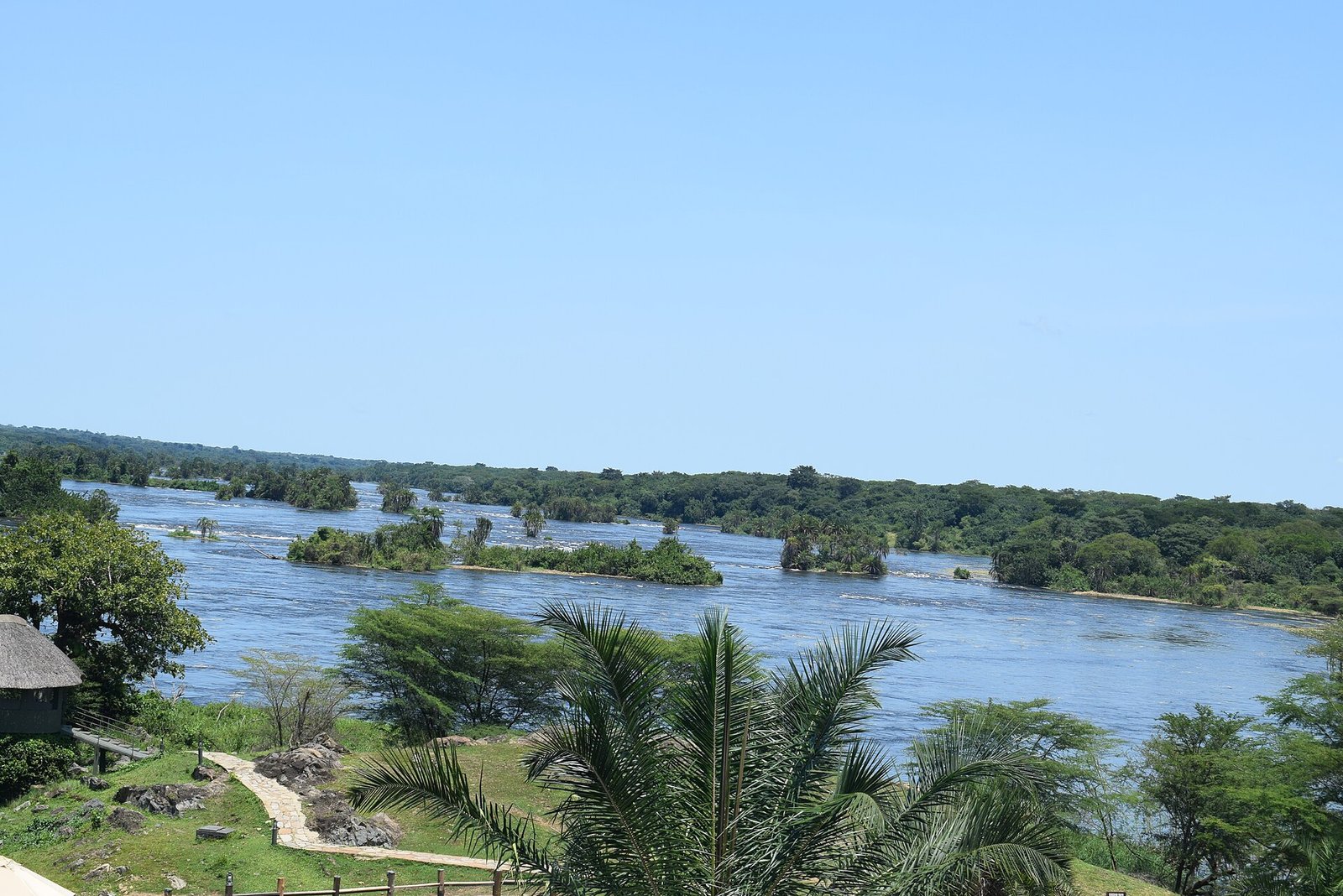
Photo: BMKME, CC BY-SA 4.0, via Wikimedia Commons (View of the River Nile from Kyobe Safari Lodge, Murchison Falls National Park, Uganda)
From Sunday, Europe stops taking East Africa's lodges at their word
On 27 September an EU consumer law makes "eco", "green" and offset-based "carbon neutral" unusable without proof. No East African lodge is under EU jurisdiction. Those that sell through European tour operators are about to discover that they do not need to be.
Sunday is World Tourism Day, and in eastern Uganda it closes three days of free national park entry that the government has pitched as an answer to the countries still advising against travel there. The more consequential event of 27 September will happen without a speech. From that day, a lodge that describes itself to a European holidaymaker as "eco-friendly", "green" or "responsible" will need something most have never been asked for: proof that a third party has checked.
The instrument is Directive (EU) 2024/825, known in Brussels as the Empowering Consumers for the Green Transition directive, or EmpCo. It was adopted in February 2024, member states were meant to write it into national law by 27 March this year, and it applies from Sunday. It creates no new regulator and no new form. It adds items to the annex of the EU's unfair commercial practices law, the short list of things a business may never do to a consumer, whatever the circumstances.
Four of those new items land squarely on hospitality. Displaying a sustainability label that is not based on a certification scheme or set by a public authority. Making a generic environmental claim without being able to show recognised excellent environmental performance. Claiming an environmental benefit for a whole business when it applies to only part of it. And claiming that a product has a neutral, reduced or positive effect on emissions on the strength of offsets bought outside the business's own value chain.
The word "annex" is doing a great deal of work. Practices on that list are banned outright; nobody has to prove that a particular guest was misled. The Finnish law firm Fondia, in a briefing for clients in May, spelt out a second consequence that should worry the region more than the first. "An environmental claim can take the form of text, imagery, graphics, or symbols, and it can also appear as a marketing name," its lawyers wrote. East Africa has a great many properties with "eco" in the name.
Stewart Moore, founder and chief executive of EarthCheck, one of the larger certification bodies, put the new position plainly to Tourism Update last week. "Broad terms such as 'green' or 'eco-friendly' carry more risk under the new rules unless they are backed by evidence," he said. "It raises the bar on both sides with greater transparency expected of the businesses making these claims and of the organisations verifying them."
The obvious objection from Nanyuki or Arusha is that none of this is East African law. That is true and nearly irrelevant. Sustainable Travel International's guidance for tourism businesses, published on 5 August, states that the rules reach companies that market to consumers in the EU regardless of where they are based. Relatively few lodges sell directly to a family in Bologna, though. Most are sold by a tour operator in Milan, Munich or Paris, whose brochure, website and sales script make claims about the camp. Those claims are the operator's legal problem. They are about to become the camp's commercial one.
Dominique Binns, a communications strategist at the impact-data company Baotree, made this argument in a piece for the Adventure Travel Trade Association back in March: African lodges face the consequences even without selling directly into Europe, because European operators featuring them in marketing need evidence for what they say. The operator carries the risk and will look for the evidence, and where it cannot find any, the easiest remedy is not a lawyer's letter to Laikipia. It is a product manager deleting a paragraph, or a property.
The largest of those operators had already moved. TUI Group states on its corporate site that it requires hotels to achieve certifications aligned with Global Sustainable Tourism Council criteria in its accommodation contracts, and recognises more than 30 standards as meeting that bar, including Travelife, Green Key, Green Globe, EarthCheck and Biosphere. From Sunday, what was a procurement preference becomes a legal shield.
The markets in question are not marginal. Kenya's Tourism Research Institute counted 91,842 arrivals from Italy and 87,556 from Germany in 2024, according to figures published by The Star in January. Tanzania's International Visitors' Exit Survey, as reported this month, puts Italy at 11.8% of the country's visitors, France at 7.3%, Spain at 5.3% and Germany at 4.9%.
Samantha Smits, a sustainable tourism consultant, framed the upside for those who can document their case in terms any sales director will recognise. Verified information, she wrote for the Adventure Travel Trade Association on 14 September, "just saves your agents doing homework, which makes you a more attractive partner to choose and easier to do business with". The inverse is the risk. A supplier whose claims create homework is a supplier that is harder to choose.
If the answer is certification, the next question is which certificate, and here the region's position is untidy. Melissa Foley of Africa's Eden told Tourism Update that many operators remain "not at all ready", and described a landscape of nearly 40 certification schemes across the continent.
Kenya's homegrown option shows how quickly the rules underneath it have moved. Ecotourism Kenya's Standard for Tourist Accommodation, the basis of its Eco-rating, was first recognised by the GSTC in October 2016. It is not on the council's list of standards that kept that status on 1 January 2025. The reason matters more than the fact. In February 2023 the GSTC gave owners of recognised standards used for certification until 31 December 2024 to do one of two things: open an application for GSTC accreditation, or sign a formal arrangement handing their audits to certification bodies the GSTC has already accredited. Failing either, the council said, "means termination". Kenya's standard sits in the terminated table of the council's 31 December list, alongside several better-known international names.
The rule was written to end a confusion the council described bluntly. Recognition, it says, "only reviews the content and wording of the standard", not how it is audited. It counts more than 200 accommodation labels worldwide, many of which "do not comply with international norms on the definition of certification", and some of which are closer to "guided self-assessments". Two Indian Ocean competitors kept their place: the Seychelles Sustainable Tourism Label and Mauritius's Blue Oasis standard both appear on the council's list of standards still recognised from January 2025. The GSTC's own programme for online travel agencies and other distributors now includes only properties with accredited certification or a currently recognised standard.
None of this says Kenyan eco-rated lodges are not doing what they claim. Ecotourism Kenya's public list, which carries no date, names 79 rated facilities, 50 of them at gold, and the scheme may since have made the arrangements the GSTC asked for. But the directive asks the same question the GSTC now asks. It defines a certification scheme as third-party verification, open to any trader on transparent terms, with procedures for non-compliance and monitoring by a third party whose competence and independence rest on international, Union or national standards. The GSTC's revised manual for the bodies it accredits took effect on 5 March 2026 with a six-month transition, and requires them to comply with ISO/IEC 17065, the international standard for organisations that certify products and services. That transition ran out this month, days before EmpCo applies. Any owner relying on a label from Sunday should ask its scheme who audits it and on what basis their independence is established. An owner who has told a European operator that its rating is "GSTC-recognised" should check the council's current list before the operator does.
The offset rule is the cleanest break. "Carbon-neutral safari" has become a familiar line in itineraries, and it usually rests on credits bought to cover flights and game drives. Under EmpCo, a neutrality claim built on offsets outside the value chain is banned outright, whatever the quality of the credits. Sustainable Travel International's advice is to reframe offset spending as "an investment in climate action" beyond the business's own operations. It is a smaller claim, and one a lodge can keep making.
The paradox is that the directive favours exactly the kind of evidence East Africa's better operators already possess. A camp that meters the share of its power that comes from solar, pays a published lease to a community conservancy per bed-night, or has removed single-use plastic and can show its supply records, has specific, measurable claims the law permits. What it cannot do is compress them into an adjective. The ban falls on "eco", not on the numbers underneath it. "If you can't measure it, you can't market it," Foley wrote on 10 September, in a guide for operators that is more useful than its slogan.
Kenya's largest European market is not in the EU at all. The UK sent 180,639 visitors to Kenya in 2024, per the Tourism Research Institute figures, and its rules are separate. They are not softer. Since 6 April 2025, under the Digital Markets, Competition and Consumers Act, the Competition and Markets Authority has been able to investigate consumer-law breaches itself and impose fines of up to 10% of global turnover without going to court.
Nor is there a single European referee. The Commission's separate Green Claims Directive, which would have set detailed rules on how claims are substantiated and verified before use, collapsed in June 2025 when the Commission said it would withdraw it rather than accept an amendment covering some 30 million micro-enterprises. The Commission was explicit that this "will not affect" EmpCo. But it means the new blacklist will be interpreted by national consumer authorities and courts, on national timetables. Fondia notes Sweden applies the rules from 1 January 2027 and Finland has a transition for certain provisions to March 2027. An operator selling in five EU markets cannot know which reading will bite first, and so it will apply the strictest one to every supplier.
Guy Bigwood, chief executive of the Global Destination Sustainability Movement, summed up the shift in May. "Sustainability is no longer just a story we tell," he said. "It is something we must prove."
What happens on Monday morning is not a raid. It is quieter and, for an unprepared property, more expensive. A European operator's content team works through its supplier pages and strips anything it cannot evidence. A property whose fact sheet says "eco-luxury" and nothing else becomes a property with a shorter description. The next time a programme is trimmed, the shorter description is easier to cut.
The work splits into what can be done this week and what cannot. This week, owners can read every surface where the property describes itself to a European reader: website, booking-engine blurb, OTA listing, Instagram biography, and above all the fact sheet held by each European tour operator and destination management company. Every adjective without a number behind it should be replaced with the number or deleted. Every "carbon neutral" line built on credits should go. A badge the property designed itself should come down.
What cannot be done this week is certification, which takes months. That is a decision worth making deliberately rather than under pressure from a contracting partner in the new year, and worth making on the basis of the directive's actual definition rather than a logo's familiarity.
East Africa's lodges have long argued that they do conservation rather than talk about it. From Sunday, Europe's consumer law takes them at their word only if someone else has checked it. The operators who can show their working have a sales advantage for the first time in years. Most of the ones who cannot will never see a fine. They will simply find, in next season's brochure, that they are harder to find.
📣 Telegram 💬 WhatsApp 💼 LinkedIn 📚 All guides