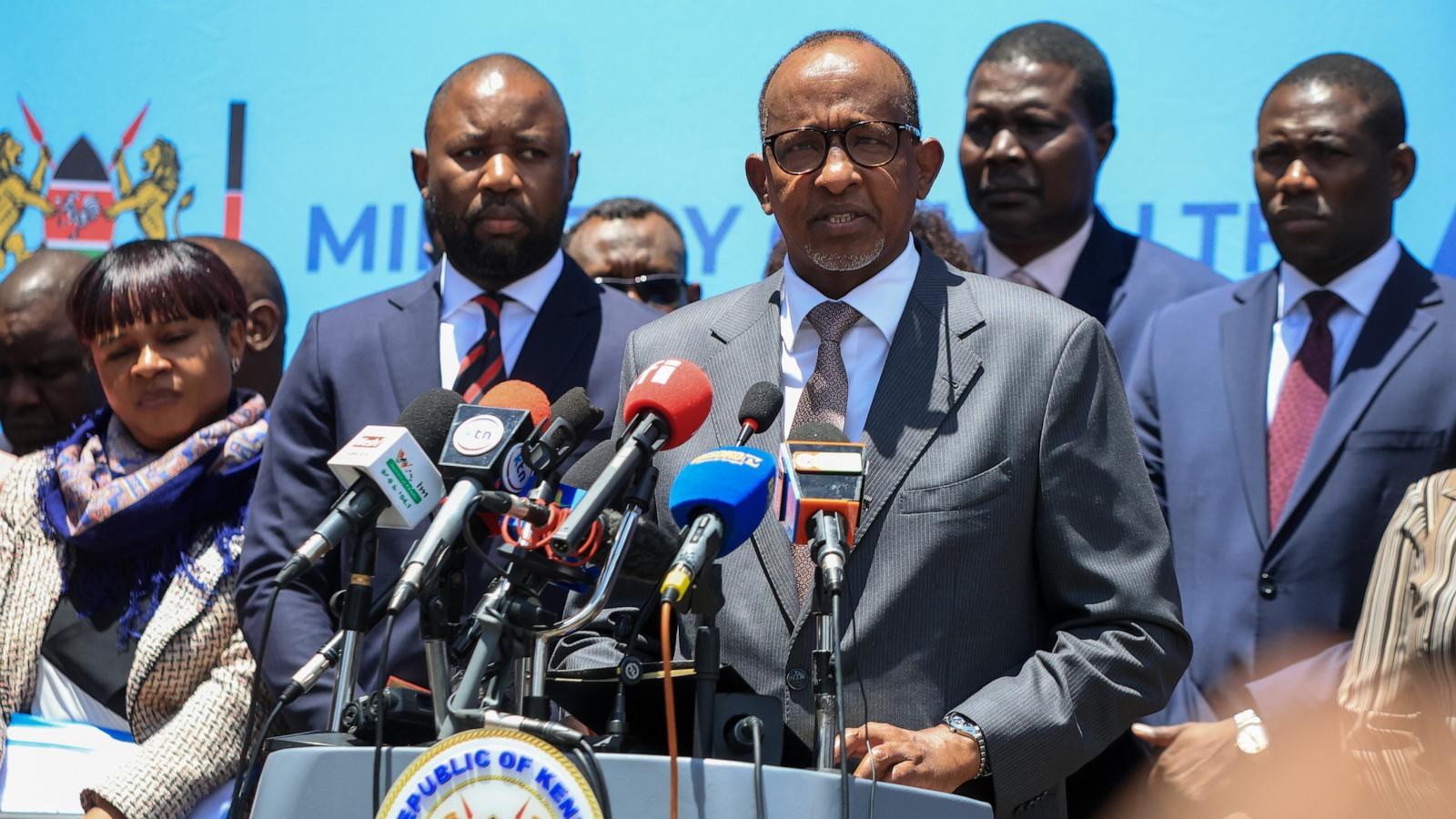
Handout: Ministry of Health, Kenya - editorial use
Kenya has one Ebola case and two contagions. Only one of them is a virus.
A single imported infection, confirmed on the opening day of Magical Kenya Travel Expo, carries almost no epidemiological risk to visitors and a great deal of commercial risk to the people who host them. The difference is worth understanding before the next one.
On Wednesday morning in Nairobi, Rebecca Miano stood in front of roughly ten thousand delegates at the opening of the sixteenth Magical Kenya Travel Expo and told them that the country was watching. "No effort, and no level of vigilance, will be spared," the Tourism and Wildlife Cabinet Secretary said, adding that her ministry was "working in close coordination with the Ministry of Health to ensure that all precautionary measures are in place." Her set-piece speech was meant to be about digital transformation and artificial intelligence in tourism, which was the expo's theme. It had become, in the space of about thirty-six hours, a speech about a virus.
The day before, on 6 October, the Ministry of Health had confirmed Kenya's first case of Ebola. Samples from a Kenyan citizen who had died in a Nairobi isolation ward on the night of 5 October tested positive for Bundibugyo virus at the National Virology Reference Laboratory and at the Kenya Medical Research Institute. According to the World Health Organization's Regional Office for Africa, which published the timeline the same day, the man had been living in the Democratic Republic of the Congo, fell ill there, was treated at several facilities, travelled by road through Beni to Kampala on 2 October, flew to Nairobi on 3 October, and was taken from the airport to hospital and isolated. Twenty-eight contacts were listed immediately, including family members and the health workers who had cared for him. Twenty-three passengers and four crew from the same flight were being traced. By 7 October, Public Health Principal Secretary Mary Muthoni put the number of traced contacts at fifty-seven, with ten in quarantine at the National Police Service Hospital.
So the sequence, from the point of view of a lodge owner in the Mara or a general manager in Zanzibar, is this: a very sick man crossed two borders, was intercepted on arrival, was isolated before the disease had even been identified, died, and was buried under Kenya's safe and dignified burial protocol. Every institution that exists to catch exactly that chain of events caught it. Dr Mohamed Janabi, the WHO Regional Director for Africa, put it in one line in the organisation's own release: "Health emergency preparedness gives us a head start." Kenya's Ebola preparedness score, by WHO's assessment, had risen from 66 per cent in May to 82 per cent in July. More than 652,000 travellers had been screened at entry points before this man arrived at one of them.
Then look at what the official machinery did next, because this is the part the industry tends not to read. WHO's statement says plainly that the organisation "advises against any restriction of travel to, or trade with" the DRC, Uganda or Kenya, on the basis of currently available information. The US Centers for Disease Control and Prevention, which maintains travel notices for this outbreak, lists Level 4 "avoid all travel" for Ituri and Nord-Kivu, Level 3 for Haut-Uele and Tshopo, and Level 2 for the DRC and Uganda overall. For Kenya it lists nothing at all. Britain's Foreign Office updated its Kenya advice on 7 October to record that "on 6 October 2026, the Kenyan Ministry of Health confirmed its first imported case of Ebola," to note the contact tracing, surveillance and border screening under way, and to tell travellers to follow local guidance and expect enhanced screening if arriving from Uganda, Ethiopia or the DRC. It imposed no restriction. The Foreign Office's existing advice against travel to Mandera, parts of Wajir and Garissa and most of Lamu remains what it has always been, which is a security judgement and has nothing to do with this.
In other words: no government has told anybody not to come to Kenya. Several Kenyan headlines nonetheless ran the two things together, and that conflation is the actual story.
Consider the comparison that almost nobody in East African tourism has made this week. Kenya is the fourth country to confirm Bundibugyo virus disease in this outbreak. The third was France. In June, a doctor working with the Alliance for International Medical Action boarded a commercial flight out of Kinshasa while almost asymptomatic, apart from headaches, deteriorated during the flight, and was isolated on landing in Paris before the disease was formally identified. The European Centre for Disease Prevention and Control assessed the risk to European residents as low. No country advised its citizens against travel to France. No French hotel association spent June briefing embassies. Tedros Adhanom Ghebreyesus, the WHO Director-General, said at the time that countries "shouldn't overreact," and on this occasion they did not.
WHO's own risk tiering, reassessed on 14 August, grades the risk as very high inside the DRC, high for countries sharing a land border with the DRC, and low for the rest of the African region and globally. Kenya does not share a land border with the DRC. By the WHO's own geography, Kenya sits in the same risk band as Britain and Belgium, and a tier below Uganda and Rwanda. Yet it is Kenyan operators, not French or Belgian ones, who spent Wednesday and Thursday answering emails from trade buyers asking whether the season was still on.
That asymmetry is not a grievance. It is a forecastable commercial fact, and East African operators already have the data to forecast it, because this exact thing happened four months ago when Kenya had no cases whatsoever.
In June, with the DRC outbreak growing and Uganda's own cases in the news, the Kenya Association of Travel Agents convened in Mombasa and its members reported what was described as a mounting surge of booking cancellations. Those cancellations came from high-value North American and European source markets, including adventure and wildlife clients heading for Nanyuki. Tourism Principal Secretary John Ololtua had to stand up and state that Kenya was Ebola-free, which at the time was true, and to explain that intensified surveillance at ports of entry was a sign of health security rather than evidence of a threat. June Chepkemei, chief executive of the Kenya Tourism Board, asked journalists to prioritise factual and contextual reporting over sensationalism. The sector's response was to brief embassies with verified epidemiological data, to equip travel agents with talking points, and to move marketing budget into crisis communication.
Read that again. Kenya lost bookings in June to a disease it did not have. The transmission channel was never biological. It was informational, and it ran through intermediaries: the agent, the tour operator's risk committee, the corporate travel manager, the conference organiser's insurer. Those actors do not grade risk by health zone. They grade it by country, because country is the only field their systems have.
Which is why the epidemiological reassurance that the sector instinctively reaches for, while entirely accurate, is aimed at the wrong audience. Virginia Messina, chief executive of the African Travel and Tourism Association, made the correct points this week, and made them well. "Ebola is not an airborne disease," she said, and "the rapid identification and monitoring of contacts following this case demonstrates the importance of those preparedness measures." Simon King, who led ATTA sessions earlier this year on handling client concerns about Ebola, offered the single most useful sentence available to anyone selling East Africa right now: in fifty years of public records, he said, "there has never been a recorded case of a leisure traveller contracting Ebola during ordinary travel." Every documented international case, he noted, involved healthcare workers, caregivers, burial teams, patient transporters, humanitarian responders, or people working directly inside outbreak settings. The man who died in Nairobi had been living in the DRC for years and had been ill for roughly a month.
All of that is true, and almost none of it will be read by the person who actually cancels. The guest who is nervous can be reassured by a lodge. The buyer who is nervous cannot, because the buyer is not making a judgement about Ebola at all. The buyer is making a judgement about whether an incident in Kenya creates a liability for their firm, and they will resolve that judgement with whatever document is closest to hand. If the closest document is a newspaper headline, the booking moves to Botswana.
So the practical conclusion for an East African operator is narrower and less comforting than "Kenya is safe." It is that the asset worth defending this quarter is the explanation, not the destination, and that the explanation has to be built for intermediaries rather than for guests.
Three things follow. First, the document that matters is a dated one-page brief that cites WHO AFRO's 6 October release and the Ministry of Health directly, rather than a paragraph of a lodge's own reassuring prose, because a risk desk will accept a citation and discount an assertion. Second, the commercial instrument that matters is a generous date-change term rather than a refund, because the June episode showed the decision being made by the buyer and not the traveller, and a buyer who can defer rather than cancel usually will. Third, the operational detail that matters is a written account of what screening and health protocol a property actually has, because corporate travel and conference business is the segment with the most formal risk procedure and therefore the segment that moves first and returns last. Kenya recorded 2.7 million international arrivals in 2025 alongside 5.2 million domestic trips, and Sh500 billion in earnings, and it enters the October to December window with the whole of that exposed to a decision cycle that begins in a compliance inbox.
There is one more thing, and it is the uncomfortable part. Kenya's preparedness score went up and its commercial exposure went up in the same quarter, and they went up for the same reason. A country that detects an imported case in a day, confirms it in two laboratories, notifies WHO under the International Health Regulations and publishes the patient's route is a country that has just handed the world's travel-risk systems a dated, searchable, country-level event. France, which did the same thing in June, paid nothing for it. Tedros said this week that "transparency should be rewarded, not punished." He is right, and it is not. Until that changes, East African operators should treat the reputational cost of good public health reporting as a known line item, prepare the paperwork before the next case rather than after it, and stop being surprised by the only part of an Ebola scare that has ever reached them.
📣 Telegram 💬 WhatsApp 💼 LinkedIn 📚 All guides