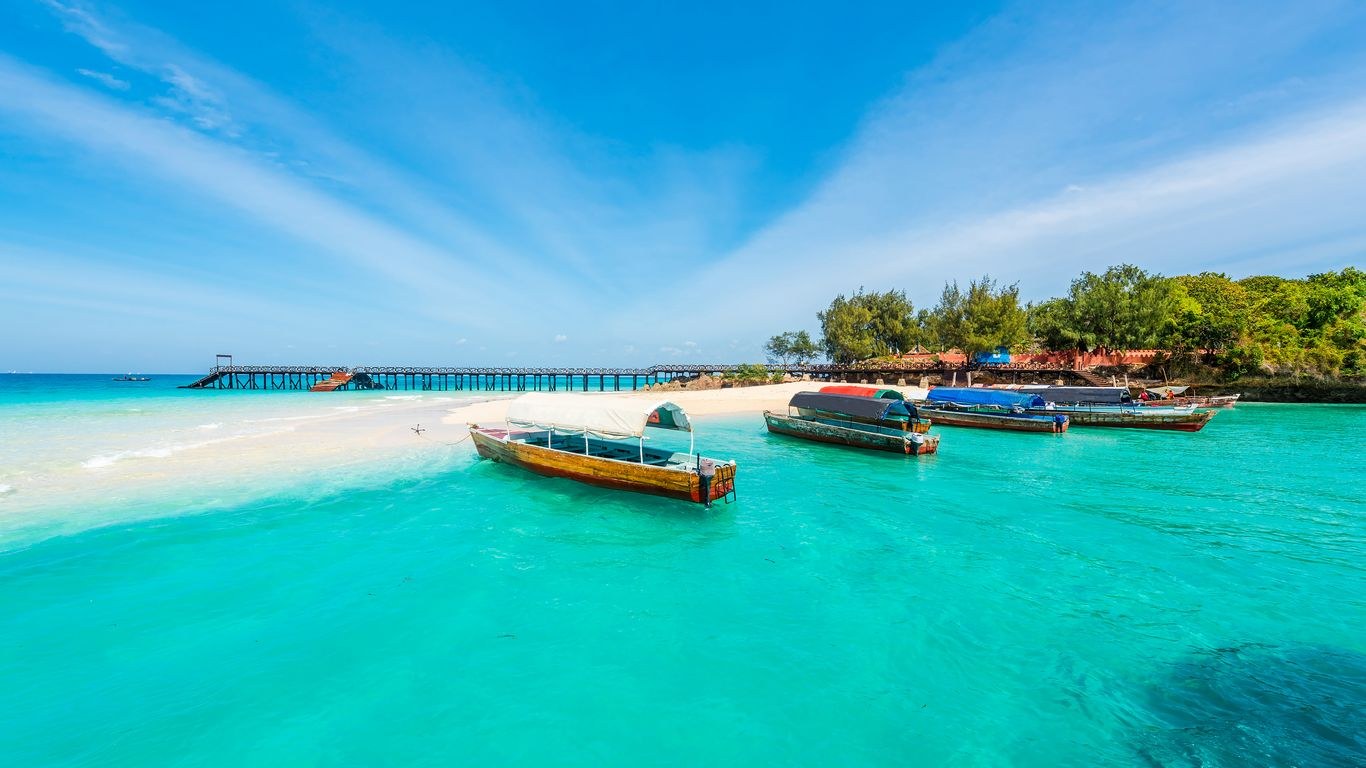
Photograph: Onyango George / EA Hospitality Pulse
Zanzibar got the seats it asked for. The room rate fell 18 per cent.
Airline capacity into Zanzibar rose 11 per cent in a year and is forecast to rise another 33 per cent by March. August set an arrivals record at an estimated 92.9 per cent bed occupancy. Over the same twelve months the weighted average online room rate fell about 18 per cent, in every category. East Africa has spent three years arguing that seats are the binding constraint. One island has now run the experiment.
On the evening of 20 October, in a five star beachfront resort that had opened on Zanzibar's coast only eight months earlier, Shariff Ali Shariff told a room of 178 foreign travel buyers that his island had outgrown its own brochure. "Zanzibar is no longer just a destination for holidays," the Minister of State in the President's Office said. He wanted conferences. He wanted Pemba developed carefully. He wanted guests who, in his phrase, "come for our beaches but stay longer." It was a confident speech to a confident room. Essence of Africa, the buyer forum hosting it, had grown its exhibitor list by 53 per cent since its first edition, and roughly three quarters of the buyers sitting in front of him were attending for the first time.
Within forty eight hours the association that convened those buyers published the figures that complicate the speech. Airline seat capacity into Zanzibar grew by more than 11 per cent in the twelve months to October 2026, with long haul seats up 26 per cent. Over the next six months it is forecast to rise by 33 per cent, split between a 36 per cent jump in domestic capacity and 31 per cent internationally. Forward flight bookings through the global distribution systems for travel to March 2027 are up 10 per cent year on year. By any measure an island tourism board would recognise, this is the thing everyone has been asking for.
In the same release, from the same analysis, came the other number. The weighted average room rate advertised through online travel agencies on Zanzibar fell by about 18 per cent over those twelve months, and it fell in every hotel category.
That pairing deserves to be sat with, because it is not the pattern the region has been trained to expect. The orthodoxy across East African hospitality for the last three years has been that demand is latent and access is the constraint: open the route, add the frequency, cut the visa friction, and rate follows volume. Zanzibar did the first part. Its arrivals in August reached 124,481, the highest monthly total in the official series, up 18 per cent on August 2025. Between January and August it received 633,228 international visitors, 10.6 per cent ahead of the same period last year, after a 2025 that closed at 917,167 and grew almost a quarter. The Office of the Chief Government Statistician put estimated bed occupancy for August at 92.9 per cent, calculated from declared intended stays, which is to say the island was as close to physically full as a beach destination gets.
Full, and 18 per cent cheaper. The market did not clear on value. It cleared on volume.
Why it cleared that way is visible in the composition of what is being sold. Of Zanzibar's hotel supply listed online, 57 per cent is three star, 28 per cent four star and 15 per cent five star. The same intelligence scores the island at 86 out of 100 on tourist perception, with security at 95 and climate at 90, and at 65 on the product index that measures what is actually there to do. Hospitality satisfaction sits at 74 overall: 77 at five star hotels and resorts, 69 at three star. The gap between a perception score of 86 and a product score of 65 is the whole argument in two numbers. Travellers like the idea of Zanzibar considerably more than they like the delivery of it, and when a majority of the delivery is three star rooms that under perform the island's own average, the only lever left to the operator holding one is price.
Arif Mazrui, general manager of Fisherman Tours and Travels and a man who has watched the island's supply curve from inside it, put the mechanism plainly at the same forum. "They're turning every corner and every building into a hotel," he said, noting that around 25 hotels and resorts have opened in Zanzibar over the past six years. Supply of that kind does not arrive with a differentiation strategy attached. It arrives as rooms, and rooms compete on the only attribute a booking engine displays above the fold.
The second mechanism is the rotation of the source markets themselves, which is where the yield is quietly leaving. In August, arrivals from the Americas fell 29 per cent year on year, with the United States down 26.1 per cent, to 5,755 visitors in total. Over the same month African arrivals rose 58.4 per cent to 30,495, with Kenyan arrivals alone up 75.2 per cent. Russia, served by direct flights from Moscow since July, rose 376 per cent to 4,298, and its forward bookings for travel through March 2027 are up 98 per cent. Forward bookings from the United Kingdom are up 51 per cent, Germany 14 per cent, France 8 per cent. Forecast inbound capacity from the Gulf is extraordinary: the United Arab Emirates up 57 per cent, Oman up 108 per cent, Qatar up 17 per cent.
Nobody should read that as a bad trade in itself. Regional and emerging market demand is resilient demand, it is cheaper to acquire, and the average intended stay on the island is a healthy 7.6 nights. But a destination that loses a quarter of its highest spending long haul market while adding charter and regional volume is not holding its mix constant, and the advertised rate is simply reporting that fact. The rooms that used to be sold to an American couple in February are being sold, and they are being sold full, at a different number.
Virginia Messina, group chief executive of the African Travel and Tourism Association, which published the analysis, said the quiet part at the forum itself. "Growth alone cannot be our measure of success," she told delegates, calling for continued investment in hospitality standards and for "protecting the quality and value of its tourism product." It is unusual for a trade body to release capacity growth of 33 per cent and then warn the room about it on the same stage. It is worth noticing when one does.
For operators on the mainland and in Kenya, this is not an island curiosity. It is the nearest thing the region has to a controlled experiment, and the control group is about to become Kenya's coast.
Kenya's national numbers look like Zanzibar's did two years ago. International arrivals reached 2,792,875 by June 2026, an 88 per cent increase on 2022, with tourism earnings up 110 per cent to Sh564 billion over the same period on Government Delivery Unit figures. Beneath the headline, the shape is familiar: conference demand has performed strongly in Nairobi while coastal leisure has not kept pace, and coastal accommodation capacity has reportedly risen from roughly 30,000 beds to around 50,000. That is a two thirds increase in supply into a segment growing more slowly than the aggregate. It is the Zanzibar precondition, assembled quietly, one property at a time.
Sam Ikwaye, coast executive officer at the Kenya Association of Hotelkeepers and Caterers, has been making the access argument that this piece is interrogating, and he is not wrong about the symptom. Without direct flights, he has warned, the national growth figure is "growth on paper" and is not felt by the industry on the ground. The Zanzibar data does not refute him. It qualifies him severely. Direct flights will convert paper growth into bodies in beds. What the past twelve months on Zanzibar demonstrate is that bodies in beds and rate per bed are now separable outcomes, and that winning the first can cost you the second if the product underneath has not moved.
More capacity is coming regardless. British Airways will fly London Gatwick to Kilimanjaro and onward to Zanzibar three times weekly from 29 May 2027, its return to Tanzania after thirteen years, running through to the end of that October. Kenya has signed marketing partnerships with Emirates and Qatar Airways. The region's seat map in 2027 will be the best it has had. The question every rate sheet being written this quarter has to answer is what is being sold on those seats, and at what.
There are three practical consequences. The first is that contracting 2027 against a seat forecast is now a demonstrably unsafe method, because Zanzibar's forward seats and its forward rates moved in opposite directions. The second is that the product index, not the arrivals number, is the figure an owner should be managing: on an island scoring 86 for perception and 65 for product, the returns to spending on what guests actually do during the day exceed the returns to spending on another room block. The third is that mix discipline has to be deliberate. A property that lets its base shift to the cheapest acquiring market because the planes are already arriving from there will discover, as the island's three star stock has, that it has traded a rate card for an occupancy statistic.
Shariff, to his credit, appears to have read his own data. His stated ambition is "to ensure that every visitor contributes more to our economy," and on the island's second island he was blunter still: "We do not want Pemba to become another Unguja." That is a government proposing deliberate scarcity in the one place it still has the option, having watched what abundance did to the rate next door. Whether Zanzibar can hold that line against 33 per cent more seats and a construction sector turning every corner into a hotel is the open question of the next eighteen months.
For everyone else in East Africa, the lesson arrives early and cheaply, which is the best way for a lesson to arrive. The seat was never the hard part. The seat was the part that could be bought.
📣 Telegram 💬 WhatsApp 💼 LinkedIn 📚 All guides